
Behavioural science can help legal workplaces understand what’s really affecting employee wellbeing, leadership and workplace culture. By looking at what’s happening beneath the surface, organisations can work out where change is needed and how best to make it happen. By Dr Nupur Yogarajah.
Behavioural science is rooted in psychology and also draws on other academic disciplines such as neuroscience and social sciences. While it has become a more recognisable term, there is often little understanding of how it can be applied to overcoming workplace challenges and improving employee wellbeing, leadership effectiveness and organisational culture. This is particularly relevant to the legal sector, a high-demand, high-pressure field with significant risks of chronic stress and burnout. This is reflected in LawCare’s Life in the Law 2025 findings, with nearly 60% of respondents reporting their mental wellbeing as low with very high levels of work intensity and low levels of psychological safety at work being significant contributors.
What can behavioural science add?
If you consider your workplace, however big or small, behaviours are happening all day, at every level: among employees, leaders and the organisation as a whole. Behaviours can be considered desirable – for example, those we want more of from employees, leaders and organisation to promote wellbeing and psychological safety. There can also be unwanted behaviours that actively damage wellbeing and culture, such as allowing rudeness or poor leadership to thrive. Some behaviours are overt, such as meaningful feedback from a leader, while others are less tangible. For example, a pervasive culture of “this is the way we do things around here” can make it clear that change or different opinions are not welcome.
Therefore, when we face a workplace challenge, or are looking to build on existing improvements in employee wellbeing, there will be a multitude of behaviours you could look at changing to achieve your outcome. Behavioural science gives us an evidence-informed way to look more closely at the micro behaviours happening under the surface of our organisation and better understand how we begin to address them through planned activities.
This is demonstrated well with the iceberg analogy, which shows how the behaviours and patterns within an organisation shape the visible outputs – the tip of the iceberg. If we superficially address a problem without understanding the root causes and behaviours, the undesirable outputs can quickly return. It’s much like removing the tip of an iceberg, only for the tip to be recreated by the buoyancy forces below.

Thinking about your workplace as a system
Behavioural science encourages us to consider our entire workplace as a system. This can help maximise the impact of what you are trying to achieve in wellbeing, leadership or workplace culture. As mentioned previously, we can think about our workplace system at three levels: employees/individuals, leaders and the organisation as a whole. Any interventions you may introduce may work at just one of these levels or across several. Understanding exactly where in your system your planned interventions will create impact is essential. This helps to avoid bombarding one layer with everything and hoping for the best – for example, providing lots of employee education and expecting to improve wellbeing without considering what also needs to change at leadership or organisational level.
We also need to consider any unintended consequences that might arise elsewhere as a result of well-intended initiatives. A robust behavioural science led analysis will provide clarity on where in your system your interventions create impact, which will be most effective, and where there may be risks of unintended consequences.
This diagram shows a case study from a law firm where behavioural science was used to help move from a reactive to a more preventive approach to employee wellbeing and better understand the factors shaping leadership effectiveness and workplace culture. Taking a deeper look at the system equipped the firm with a clearer understanding of how to bring about long-term change through a series of recommended interventions. These interventions were based on research-grade analysis and behavioural modelling of the firm’s own employee written and focus group data. The focus groups were conducted in a way that protected psychological safety and anonymity, helping people to give honest and reliable answers.
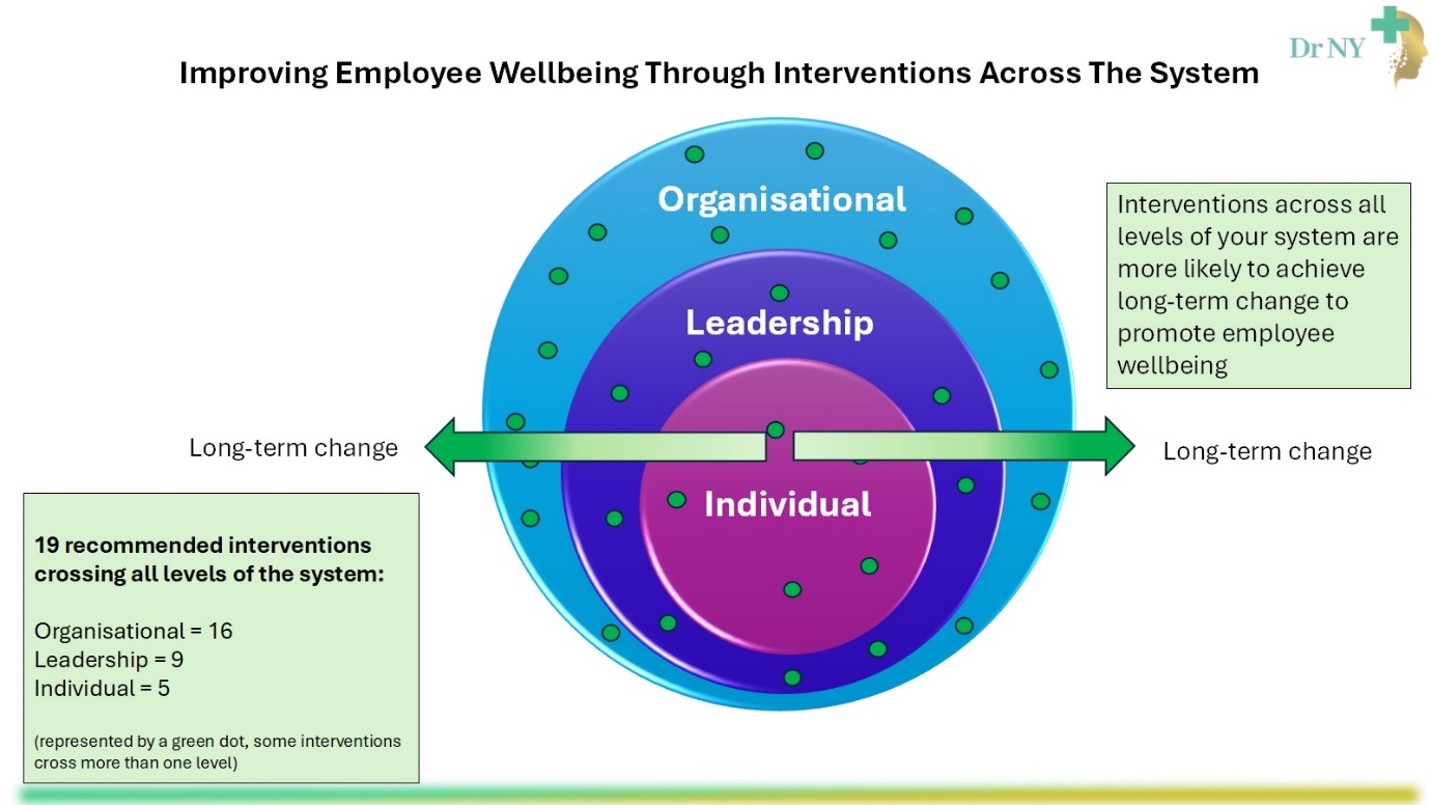
The diagram above shows a behavioural science guided deep dive diagnostic project focused on employee wellbeing, leadership and culture in a law firm. It shows how interventions can act across different levels of an organisation. In this example, 19 recommended interventions were identified across the individual, leadership and organisational levels, with some acting across more than one level. Importantly, most sat at organisational and leadership level rather than with the individual employee. Taking this systems approach helps avoid placing responsibility for wellbeing predominantly on individuals and instead considers the wider factors that need to change to support longer-term improvement in employee wellbeing. Of the 19 interventions identified, only 6 required external support, demonstrating that this type of analysis is not necessarily about commissioning lots of additional external work. Much of the change identified can often be implemented using existing internal resource and expertise.
What could a behavioural science and evidence-informed approach in the legal sector look like?
The case study above is an example of a behavioural science informed organisational deep dive or diagnostic project. Whilst this was done at scale, diagnostics can be adapted to fit the particular challenge within a law firm. This could include:
- An evidence-informed organisational screening exercise to identify areas of strength and concern across wellbeing, leadership and culture, and provide an initial indication of where further investigation or activity may be most useful.
- A more in-depth, organisation-wide project to understand what is driving areas of strength and concern across wellbeing, leadership and culture, and creation of a roadmap for where and how to focus interventions.
- A focused project to help navigate a leadership or HR change or merger, looking at how this is managed across the organisation to support positive outcomes internally for employees and externally for clients and other stakeholders.
- A focused project to identify the factors within your organisation that increase the risk of or protect against burnout, using these insights to develop more effective prevention, support and crisis interventions.
- The development or implementation of a new strategy or policy where good uptake and engagement from employees, teams and leaders will be important to its success.
The value of taking this approach is not necessarily about introducing more initiatives, as organisations are often already doing a great deal. Behavioural science can help us understand why some of those activities are having the desired impact and others are not, where there may be gaps, and whether attention is being directed towards the right parts of the system.
Ensuring organisational interventions are evidence-based
Not every organisation will need or want to undertake a diagnostic project or lighter screening exercise. However, the same evidence-informed thinking can be applied when considering training, workshops, apps or coaching. It is important to be clear about the evidence behind what your organisation offers and to collect the right data to understand whether interventions are actually having the intended impact.
The Society of Occupational Medicine’s (SOM) “Buyer’s Guide for Wellbeing Products & Services” emphasises the need for evidence-based wellbeing products and services to have confidence they can address the intended outcomes such as improving retention and performance and reducing work-related ill health. This guide provides useful information for those buying wellbeing services to consider, to ensure their suppliers are incorporating available evidence in their products.
Bringing it all together
When developing workplace interventions for wellbeing, health, leadership, culture or another “sticky” workplace problem, some useful things to consider are:
- Look beyond the most visible problem and consider the behaviours and factors contributing to it. Behavioural science-based analysis of your organisation’s data can help with this, and what emerges may be different from what you expected.
- Consider where change is actually needed across your organisation. If the problem sits partly within leadership, culture or organisational structures, focusing activity predominantly on individual employees is unlikely to address it.
- Implement interventions at a steady pace. Doing fewer things well is generally better than introducing multiple difficult to achieve initiatives at once.
- If you are commissioning an external provider, whether for a diagnostic project, wellbeing app, webinar, leadership programme or coaching, ask what evidence supports their approach and how they will assess its impact.
Some interventions will be relatively straightforward whilst others will be more challenging and slower to change. Employee health and wellbeing is complex and requires ongoing attention, particularly in demanding working environments such as the legal sector. Behavioural science does not provide a quick fix, but it can help look beneath the surface, understand the factors shaping our organisational outcomes and help us make more informed decisions about where and how to intervene.
Article first published October 2026.

Dr Nupur Yogarajah is a Behavioural Scientist, Clinical Leader, GP and Founder of Dr NY. She works with organisations to diagnose, design and deliver evidence-informed approaches to workplace wellbeing, leadership and culture, using behavioural science and a clinical leadership lens to understand what is driving organisational challenges and where to focus activity to bring about meaningful change.
If you would like an informal discussion about any of the issues raised in this article, or how behavioural science could help you better understand a wellbeing, leadership or culture challenge within your organisation, please get in touch.



We're here to listen… without judgement
Contact our free, confidential, emotional support service for the legal sector
Sign up to our newsletter to receive regular support, tips, guidance and news on mental health in the legal sector.
"*" indicates required fields