
If you’re not yet in the conversation about moral injury in the legal sector, you are falling behind.
What is moral injury?
Moral injury is distinct from both burnout and vicarious trauma, in that it arises from a different root cause and requires a different intervention. Many firms have invested heavily in burnout prevention and wellbeing initiatives. But if a proportion of disengagement and attrition is driven by unresolved ethical conflict, firms may be addressing symptoms rather than causes, reducing the effectiveness of existing investment.
It is important to distinguish moral injury from moral distress. The latter may occur occasionally when we are required to take actions within the normal course of our role, in line with regulations and professional obligations, which conflict with our personal morals and values. In these moments we may feel guilty or helpless. This response is simply a sign that you are a good person who cares about doing the right thing.
However, due to the systemic constraints we must work within, some legal professionals experience moral distress on a regular basis, even daily. If this is unsupported and unprocessed, it can become moral injury – the emotional and psychological harm caused when we are required to consistently act in ways that conflict with deeply held values, or work within a system which we perceive as causing harm that we cannot prevent.
What does moral injury look like in practice?
Moral distress (and therefore moral injury) can occur across all practice areas, for example any action you take that is legally the right thing to do, but doesn’t feel like the right thing to do from an ethical perspective. People won’t speak out or push back on this because it is part of the role, part of being the best lawyer you can be. Even though doing so may create significant ethical discomfort.
Those working in commercial law may be much less likely to experience vicarious trauma, but moral injury can still occur. For example, having to structure a deal for a large property developer, which you know will take away affordable housing in a deprived area. Or drafting terms that heavily favour a company and are hard for customers to understand or challenge.
Some practice areas are at higher risk of experiencing moral distress and developing moral injury. Here are a couple of examples, but this is in no way an exhaustive list:
- Immigration lawyers repeatedly have to deliver outcomes they ethically disagree with to vulnerable clients, while feeling powerless to change a system they feel is discriminating or causing harm;
- Family lawyers regularly watch children remain in potentially harmful situations while legal thresholds prevent action;
- Criminal defence lawyers must defend their client to the best of their ability, but may feel conflicted about the outcome;
- Employment lawyers have to structure and implement redundancy agreements, which protect the company but cause distress and harm to individual employees;
- Insurance lawyers may work regularly to minimise payouts to vulnerable claimants.
The key point here: objectively, nobody is doing anything wrong or behaving unprofessionally. All these individuals are simply doing their job, to the best of their ability, within the parameters set by the system. And that is what makes moral injury so insidious and hard to name.
How prevalent is moral injury?
The difficulty with answering this question is that the legal sector doesn’t have a language for the phenomenon. Firms already monitor burnout, stress and workload, but people rarely go to exit interviews and say, “I’m leaving because of moral injury”.
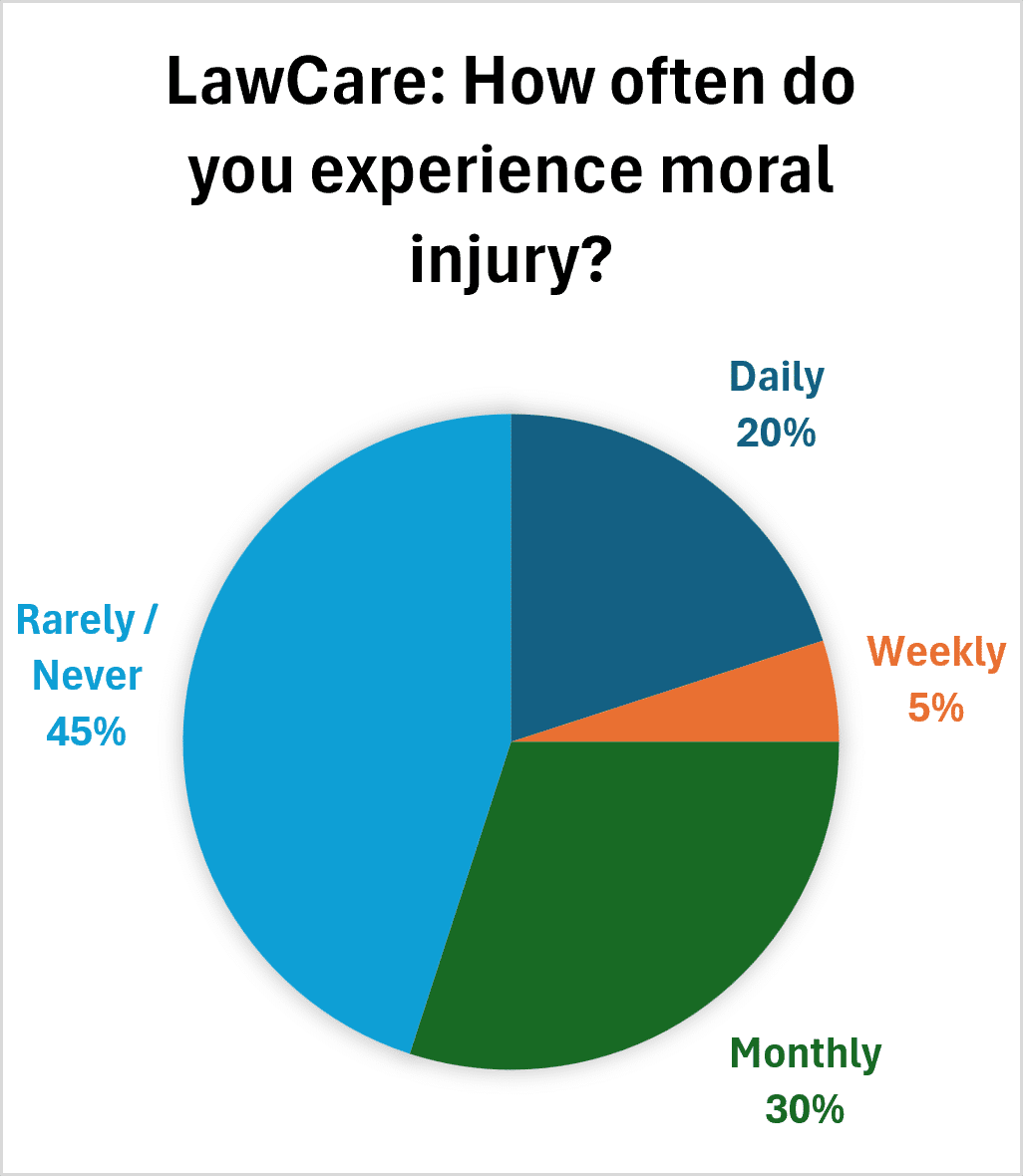
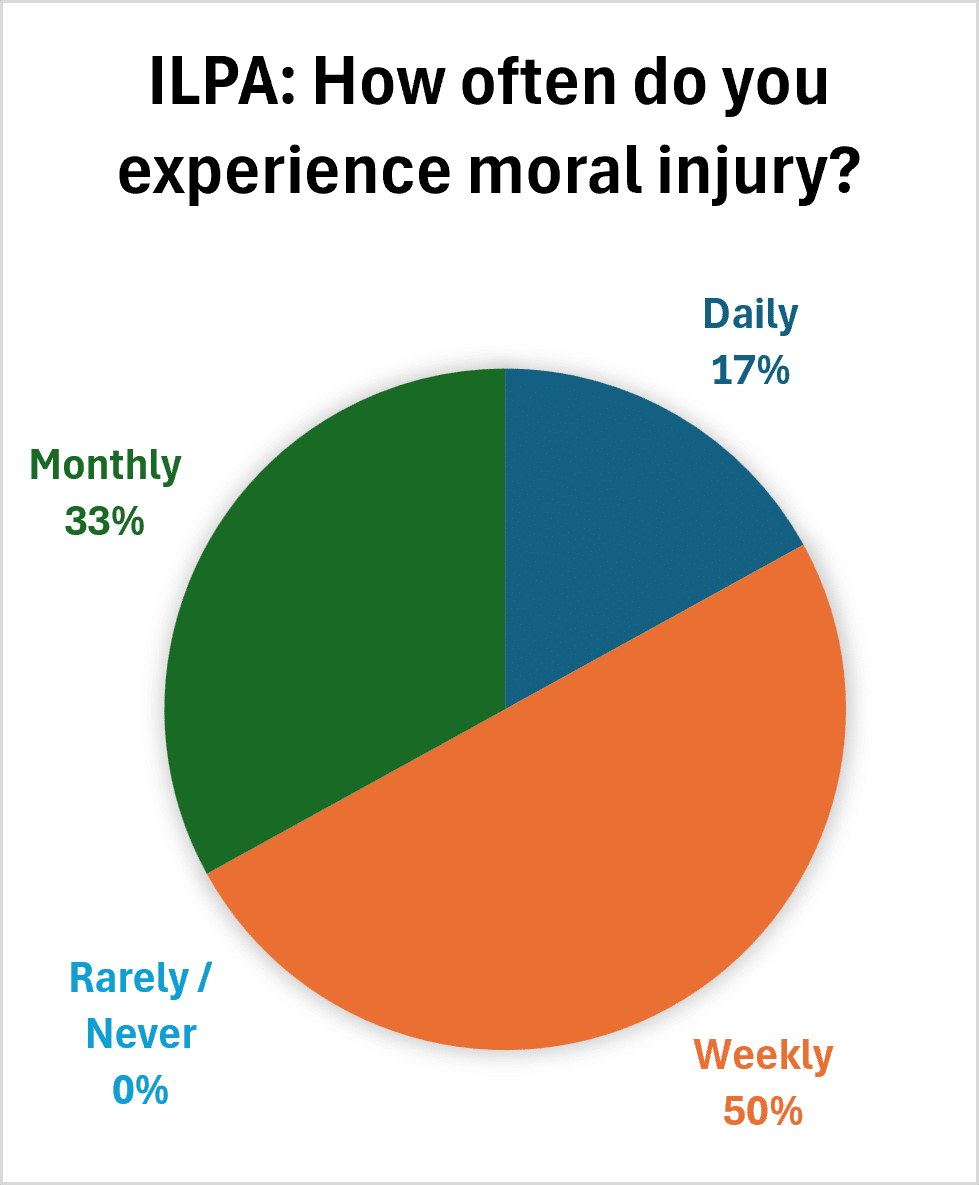
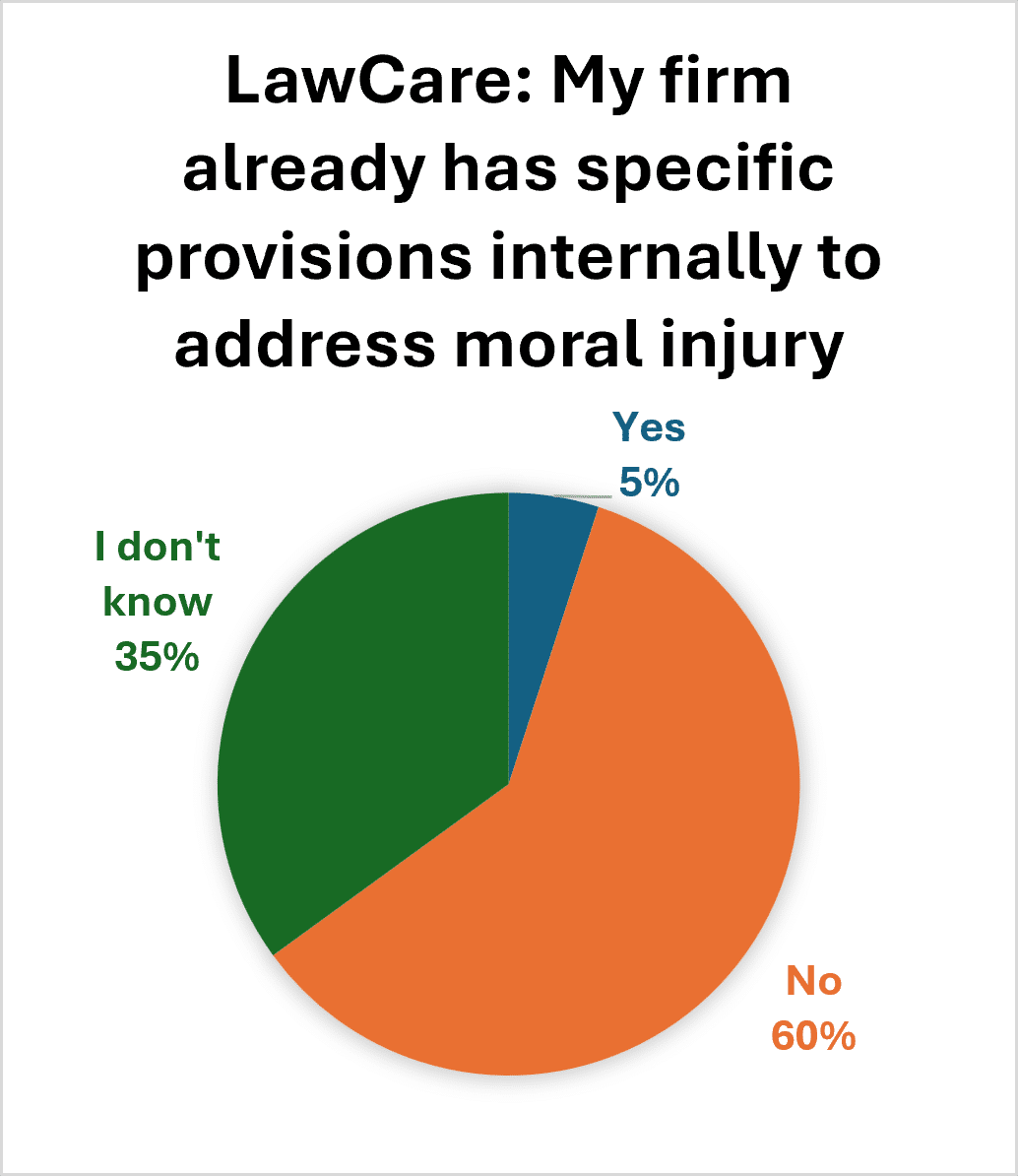
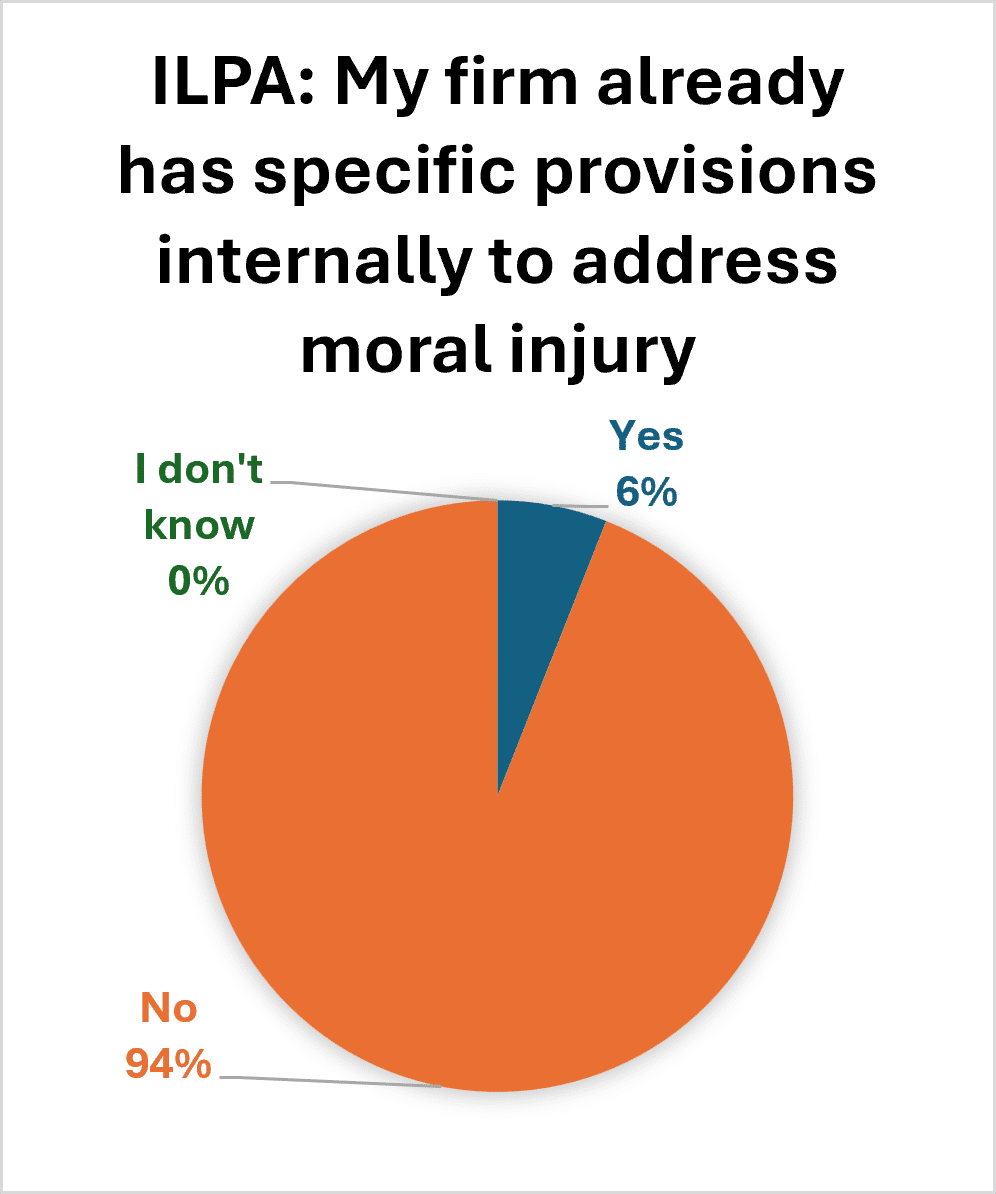
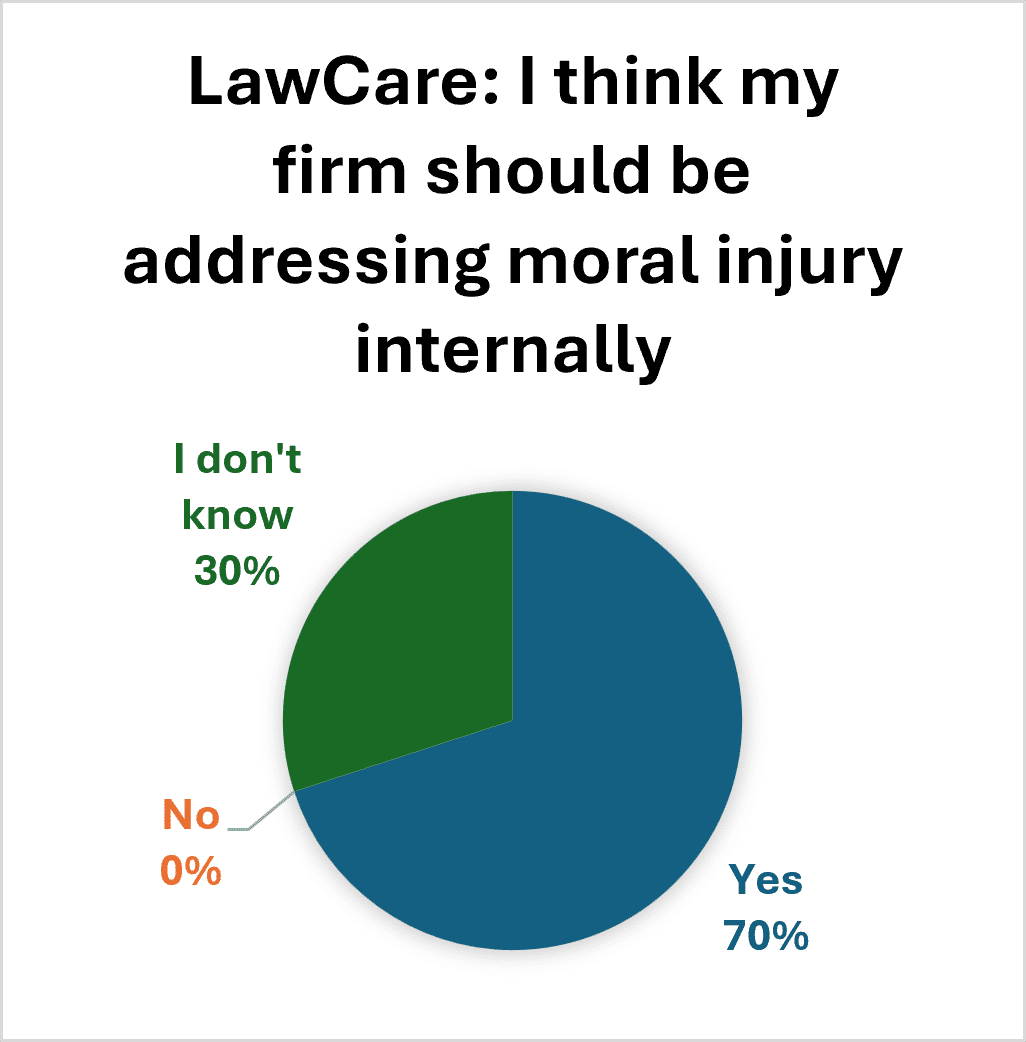
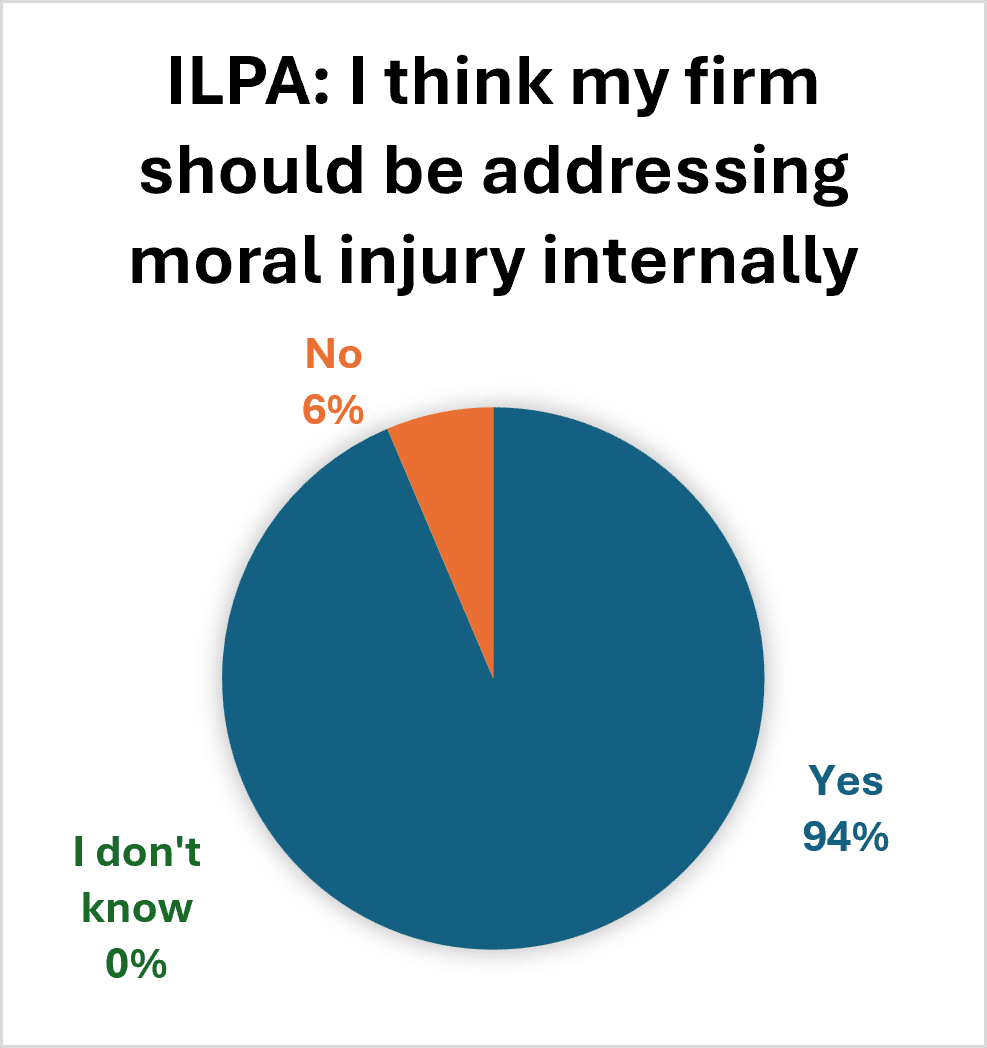
Step One – Assess: If you want to know if this is relevant in your firm, don’t guess, ask. Using awareness raising events as a platform (see below for further information) you can run polls like the one below. You can also add this as an explicit question or option within exit interviews, which will enable differentiation between how much attrition is burnout-driven versus values-based attrition. I’m happy to provide consultation on what this could look like in your firm – please get in touch.
Within the last couple of months, I’ve run polls with webinar attendees. The results are striking. In a small poll of immigration lawyers (Immigration Law Practitioners’ Association – ILPA), all poll participants indicated that they experience moral injury to some degree, while 20% of the LawCare webinar attendees (from a variety of practice areas) experience it on a daily basis. It is also evident that there is a significant gap between the provision currently available to address this and the support that people would like to see.
The commercial cost of moral injury
When ethical conflicts become chronic, firms pay for it in subtle ways that show up in performance, engagement and attrition:
- fee earners quietly disengage and put less discretionary effort into their work;
- talented lawyers become reluctant to take on leadership responsibilities;
- errors increase and work becomes slower because people are emotionally exhausted or over-checking work;
- rainmakers gradually withdrawal from the activities that drive firm performance;
- junior lawyers decide they no longer want a long-term future in the profession;
- your most conscientious people decide to leave because it “doesn’t feel right”.
One of the greatest risks is that moral injury disproportionately affects the people firms most want to keep. Those who care deeply about clients, ethics and doing excellent work are often the least willing to tolerate repeated moral conflicts. Rather than becoming disruptive, they disengage quietly or leave altogether, creating succession challenges that may not be recognised until years later. Furthermore, there is growing evidence that many younger lawyers place a high value on alignment between their work and their personal values, meaning unresolved ethical conflicts may carry increasing retention implications.
Because firms rarely measure moral injury explicitly, these costs are often attributed to burnout, changing expectations or a lack of resilience. As a result, firms may be trying to solve the wrong problem.
Firm culture and reputation are also impacted. Repeated and unresolved moral conflicts feed into workplaces where people stop challenging, stop speaking up and stop bringing their best selves to work. Over time this creates cultures characterised by cynicism, emotional detachment and quiet disengagement.
Moral injury is a risk and compliance issue
During the webinar, I argued that moral injury should be of interest not just to HR, L&D and leadership, but also to roles related to Responsible Business.
Lawyers are trained to exercise judgement, raise concerns and act ethically. But is people are disengaging psychologically, normalising uncomfortable situations or becoming reluctant to challenge, this creates risks for supervision, learning and best practice.
Employers already have a duty to protect employees’ health, which includes psychological health, not just physical safety. In the UK, under the Health and Safety at Work etc. Act 1974, employers must take reasonable steps to reduce foreseeable risks to health.
Other experts in this area argue that if people are repeatedly put in situations that cause unresolved ethical conflict, and if we know that this impacts their mental health and performance, then this becomes a foreseeable workplace risk that sits alongside more widely recognised risks like burnout and vicarious trauma.
This article goes further, arguing that as understanding of moral injury develops, it is conceivable that employers who fail to address foreseeable and preventable ethical stressors may face similar questions to those already arising in relation to workplace stress and psychological injury.
This is not fearmongering; this is advanced warning of a commercial challenge that is gaining visibility, and that firms can proactively mitigate now.
How to mitigate the impacts of moral injury on wellbeing and performance
Now for the good news: there is a lot that firms can do to begin to address this immediately.
Empresa Psychology supports law firms to identify and address moral injury, both preventatively and after it has occurred. Through years of reviewing the existing literature and distilling effective, evidence-based strategies to support teams and individuals, we have created the RAILSTM Framework that offers firms a practical structure for action:
- Recognise: You can’t fix a problem that you can’t see or name. When I deliver training on this topic, the most common piece of feedback I get is: “It’s so good to have a name for this experience”. Raising awareness is a powerful starting place and can be done easily through introductory webinars or as part of away days and awareness week initiatives. Developing a shared language in your firm can have an immediate positive impact.
- Avert: Prevention is better than cure and this is a key way to avoid detrimental impacts on both wellbeing and performance. This is particularly impactful with trainees and junior lawyers (particularly in light of the high attrition levels we’ve seen in the last couple of years within this cohort specifically). One solution I always recommend: embed this module into your trainee induction programme. This will equip the incoming generation of lawyers with the knowledge to spot moral distress as it occurs, and use the appropriate tool to process it and prevent it from developing into moral injury.
- Intervene: The reality is that many firms have individuals and whole teams who have been experiencing moral injury for years. These teams require more advanced interventions and workshops tailored to specific team contexts. The effective interventions are specific to moral injury and not strategies you will find in your standard wellbeing resources.
- Lead: It is widely accepted that leaders have a significant impact on firm culture and on the wellbeing of those they manage. There are multiple ways we can equip leaders to address moral injury from the ground up. Firstly, it is usually those in leadership positions who will be empowered to act on and escalate any ethical issues that require a resolution (as opposed to those that arise in the course of usual legal work). Secondly, leaders are likely to have experienced their own moral injury, but will need a different type of support to identify and address this within themselves. And finally, most managers are equipped with the skills to have practical conversations about workload, but some will benefit from further upskilling in handling conversations about ethical conflicts effectively and supportively.
- Sustain: Like burnout and vicarious trauma, addressing moral injury is not a one-and-done because the experiences that cause it are ongoing. Providing regular processing spaces for teams, particularly those in high risk practice areas, will embed learning that has occurred through training, and provide the final piece of the puzzle for creating sustainable resilience across the firm.
Next steps:
If your firm has recently experienced unexpected attrition, disengagement or lawyers saying they have “fallen out of love with the profession”, there is a possibility that unresolved ethical conflict is contributing. The problem is that without language for moral injury, you may never recognise it.
Ask yourself these questions:
- Retention: Are we losing conscientious people and mislabelling the cause? How do we know?
- Performance: Are we treating symptoms while missing the underlying issue?
- Culture: Are ethical conflicts becoming normalised?
- Risk: Is this foreseeable risk receiving the same attention as burnout and vicarious trauma?
Get in touch with me today to start this conversation, find out the answer to these questions within your firm, and take action.

Dr Natalie Isaia is a Clinical Psychologist and CEO & Founder of Empresa Psychology.
Empresa Psychology partners with firms to implement evidence-based strategies, helping your lawyers manage moral injury, protect wellbeing, and safeguard both engagement and long-term commercial performance.
In January 2026, Natalie wrote this article for LawCare as an introduction to the concept of moral injury, a widespread but largely unrecognised risk factor facing law firms. She then delivered a more in-depth introductory webinar in June 2026, which this article summarises.
We're here to listen… without judgement
Contact our free, confidential, emotional support service for the legal sector
Sign up to our newsletter to receive regular support, tips, guidance and news on mental health in the legal sector.
"*" indicates required fields